Welcome to Part 2 of our cruise to Glacier Bay in Alaska. At the end of Part 1 we were in the village of Pelican, on Lisianski Strait near the north end of Chichagof Island. We are near Glacier Bay now, but first stopped in at the hamlet of Elfin Cove on the south side of Cross Sound.


The main drag in Elfin Cove.

Stopping in at the local joint for a mid-day beverage.

Genuine local artifacts from the store.

Paddling along the rocky shores of the Inian Islands.
===============
Finally, crossing over to the north side of Cross Sound, we get our first glimpse of mountains and glaciers.

This is the south end of the Brady Glacier, viewed from Taylor Bay.

View from our anchorage in Dundas Bay.

The dock at Gustavus, where we picked up my sister Erin who flew up from Vancouver via Juneau.

Glacier Bay Map

Heading up into Glacier Bay, we encountered several Humpback whales feeding in fairly shallow waters.

This whale we watched for a while as it swam back and forth with its mouth open scooping up whatever goodies were there just at the surface.

Cruising up the east arm of Glacier Bay (Muir Inlet), we start to see bits of floating ice, this one with gulls along for the ride.

Our goal was to see the McBride Glacier. However the glacier was some ways up this ice-choked side inlet, which did not look like good cruising for the Raven Song.

So we found a spot to anchor for a while (not easy, given the terrain), and set out in the dinghy.
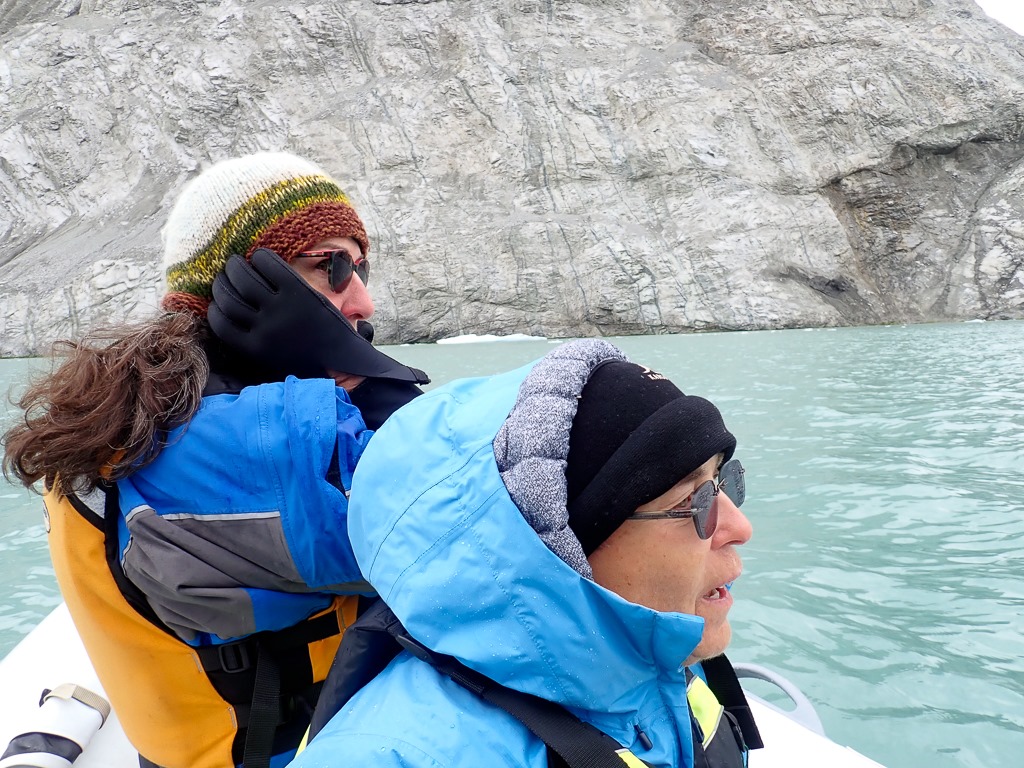
Janet and Erin in the dinghy, dressed for glacier viewing.

It was much further than we expected up the channel. We dodged floating ice and passed bergs covered with seals.

Finally we were rewarded by the sight of this wall of ice – the face of the glacier. We hung around for a while and watched some calving. The waves made tinkling sounds among the bits of floating ice.

Back out in the main inlet, we go ashore and Jan finds a stylish new hat!

The Riggs Glacier, which no longer meets the sea.

After a long, windy and rough day of cruising from Muir Inlet around and up the west arm of Glacier Bay, we anchored in front of the Reid Glacier. There is a strong and icy wind blowing from the glacier. The Reid Glacier is an arm of the Bray Icefield, which also meets the sea at Taylor Bay.

The next day the wind had settled down so we took the dinghy ashore to explore the glacier.

The glacier didn’t quite meet the sea, with rushing streams coming from under the ice.

Janet explores a crack in the ice.

That looked like fun, so Erin rushes over to do the same.

I put on my ice spikes and climb up onto the glacier itself. It was steeper and more treacherous than it first appeared!

My view back down the glacier, with Raven Song a speck in the distance.

Alpine flowers (at sea level…) among the rocks.

On the way back, Jan stashes some excellent well-aged cocktail ice in her backpack.

Our first sight of the Margerie Glacier, at the head of Tarr Inlet. This is the one that the cruise ships stop at (limit 2 cruise ships per day in the park).

Jan and Erin ready for some serious glacier viewing.

We hang around for quite a while waiting for some calving action. Not much happened – it was a quiet day.
This was the northernmost point of our trip. The date was July 11.

We found anchoring depths near the glacier, so decided to stay the night. Jan made a surprisingly good seaweed lasagne – using the kelp she harvested previously on the outer coast.

The next morning we launched the kayaks for some exploring.


Black ice!

Where to now?

Strolling among grounded bergs.

Selfie in Glacier Bay.

Johns Hopkins Inlet. Spectacular mountain scenery and water dotted with bergs.

The face of Johns Hopkins Glacier.

Just another glacier cascading into the sea.

Leaving Johns Hopkins glacier, Erin is transfixed by the rock climbing possibilities along the inlet.

On our way south now, with our park permit expiring soon, we anchored behind Russell Island next to a large creek delta.

Taking the opportunity to stretch our legs, we wandered around on the gravel flats.

The gravel was dotted with animal tracks including numerous bear prints.

Our last wildlife encounter in Glacier Bay was this moose on the shore of Geikie Inlet.
The next day we left Glacier Bay, dropped Erin off at Gustavus, and continued our journey – now heading south.

Heading south across Icy Strait, we stopped at the Native village of Hoonah.

Hoonah has embraced the tourist industry, with their own cruise ship dock just outside of town.

Just outside of Hoonah, I pull in another halibut.

Janet gets to work – she has become quite good at filleting halibut.

And that night we have an excellent halibut dinner.

Approaching Juneau – this is the Pt. Retreat lighthouse at the north end of Admiralty Island.

A picture of our navigation screen. We can see that just on the other side of Pt. Retreat, there is a cluster of boats (the blue triangles) in a circle. These are all whale watching boats from Juneau, and in the centre of the circle there is a much-observed whale.

Heavy traffic near Juneau – this is the Norwegian Bliss.

Finally arriving in Juneau. Four cruise ships at dock, plus the Norwegian Bliss, which just left, represents about 10,000 tourists looking for entertainment.

Passing through the harbour on our way to the marina, we were buzzed by a constant stream of sightseeing planes.

I find it interesting now, to discover that I didn’t take any picture of our time in the attractive town of Juneau. Except for this excellent purple lettuce salad which was part of the best restaurant meal of the whole trip.

Leaving Juneau, we dodge another load of incoming tourists.

We are heading south, bound for Tracy Arm, passing occasional bergs.

Spectacular mountain scenery all the way up Tracy Arm.

Plus waterfalls.

The bergs are getting bigger.

Even though we started at 5am to head up Tracy Arm, this cruise ship had beat us up there. Fortunately they were leaving, so we had the place to ourselves.

Finally, we come to the Glacier at the head of the inlet.

Jan, ready to fend off bergs as we approach the glacier face.

Settled in for glacier viewing!

A close up of some of the ice towers.

We are off the chart! Our navigation screen shows us as being well up on the glacier even though we are about half a mile away. Just another testament to how all these glaciers are receding.

Jan takes a break from viewing to scoop up more cocktail ice.


The Sawyer glacier at the end of the north arm of Tracy Arm.

We found a shallow spot by this waterfall, so we anchored and spent the night.

The shallows kept the big bergs away, but we did have to deal with some smaller ones.


Next morning we went exploring in the kayaks.


The bergs came in all kinds of interesting shapes.


The steep terrain did not offer many spots to land, but we found this little sandy spot for a break.

The clear blue ice shows up when a berg has rolled over. All the ice in the picture is one big berg.

Next to Tracy Arm is Endicott Arm. Part way up Endicott Arm we turned off and anchored at the entrance to Ford’s Terror. The landscape is dramatic.

We took the dinghy through the narrow entrance into Ford’s Terror, and were met with a stunning alpine landscape. It feels like we are on an alpine lake high in the Rockies, but here we are on an arm of the ocean!

Very early the next morning, as we leave Endicott Arm, another cruise ship is on its way in.

A ways to the south, there is a place called the Sandborn Canal. We stopped and paddled a long way up the river. There were lots of salmon, and bear tracks further up, so we didn’t stick around long.

In the anchorage, salmon were jumping everywhere. I am very keen to catch one!

The salmon weren’t biting, but I came back with this nice flatfish.

Pybus Bay, on the south side of Admiralty Island. There is a long story here involving bears and underwear, and also sea lions slaughtering salmon….

We had a very close encounter with a whale as we crossed Frederick Sound.

Jan’s friend Petra joined us. We picked up Petra at Kake, where she flew in to from Juneau after having spent a week on a tour of Glacier Bay.

Out in Frederick Sound we came across a group of Humpback whales. When we saw them all dive at the same time we knew to watch for bubble-netting behaviour.

Sure enough, a few minutes later the whales surfaced simultaneously. Coming up vertically with their mouths open, scooping up the fish they had corralled in their bubble net.

We watched the whales for quite a while, as they worked their way along a tide line. It was an awe-inspiring sight.
Not to be outdone by the Humpbacks, back over toward shore we could see a group of Orcas racing around and leaping out of the water – clearly on the hunt for something. We didn’t know which way to turn but in the end the Humpbacks held our attention.

Jan brings in the crab trap, with several crabs and a huge sun star.

Petra and Jan out for a paddle.

We are anchored in Ideal Cove, near the mouth of the Stikine River, and just across from Le Conte Bay, which is our destination for tomorrow.

Cruising up Le Conte Bay, we pass the first of several large icebergs. Le Conte Bay has a bar across the entrance, so the cruise ships can’t come up here.

We catch our first sight of the Le Conte Glacier. This is the southernmost tide-water glacier on the west coast. As is common, a brisk wind is blowing down off the glacier.

Nosing in carefully for a closer look.

Le Conte was the most active calving glacier that we visited. We saw several huge chunks of ice crash into the water. The most amazing thing, however, was the huge chuck of black ice that spewed out from underneath the glacier.

Raven Song at the dock in Petersburg. Petra had had a good trip and offered to buy us dinner at the best place in town before she left to fly back home. But the only decent place to eat in town was only open for breakfast and lunch.


Petersburg is tidy and proud fishing town.

Dramatic evening light in Petersburg harbour.

Leaving Petersburg, we transited Wrangell Narrows – narrow and winding but well-marked.

Approaching Wrangell.

Finding good food in these small towns is always a challenge. Jan is hopeful, but I think we were fortunate that they were closed.

We rode our bikes through town and out to the petroglyph beach. There were many petroglyphs on the rocks but they were difficult to see.

Jan making a rubbing on a reproduction petroglyph at the interpretive site.

People! What are all these people doing here? Well, they are watching bears – look, there’s one now!

We are at the Anan Creek bear watching reserve. The reserve is run by the Forest Service, and we were lucky to get a last minute permit to enter.

There were lots of salmon in the stream, and lots of bears. Some bears were better fishers than others, and size didn’t matter when it came to getting the best fishing spots – the big bear above had to wait its turn.

Other predators joined in the feast.

A mother bear with her cub.

The cub climbs a tree to stay out of trouble.

Early morning fog in a calm anchorage.

Another stream to explore, looking for salmon and bears.

We anchored in Thorne Bay, on the west side of Clarence Strait, and I decided to take the dinghy out in the evening to try some fishing. By now I was desperate to catch a salmon. I had fished here, there and everywhere and tested Jan’s patience with no success. But this evening I encountered a school of Coho and landed this nice one. I was very, very excited!!

Jan, however, had been busy while I was out fishing and just pulled this roast chicken out of the oven when I arrived….

But Jan is a very good sport, so she put on a smile and went to work on the salmon.

So we had an excellent salmon dinner that night. (The chicken we had for lunch the next day.)

Nearing Ketchikan, the commercial traffic increases. This is another one of those supply barges that bring most goods to Alaska.

The ferry (a.k.a. the Alaska Marine Highway), and float planes, are how people get around in southeast Alaska.
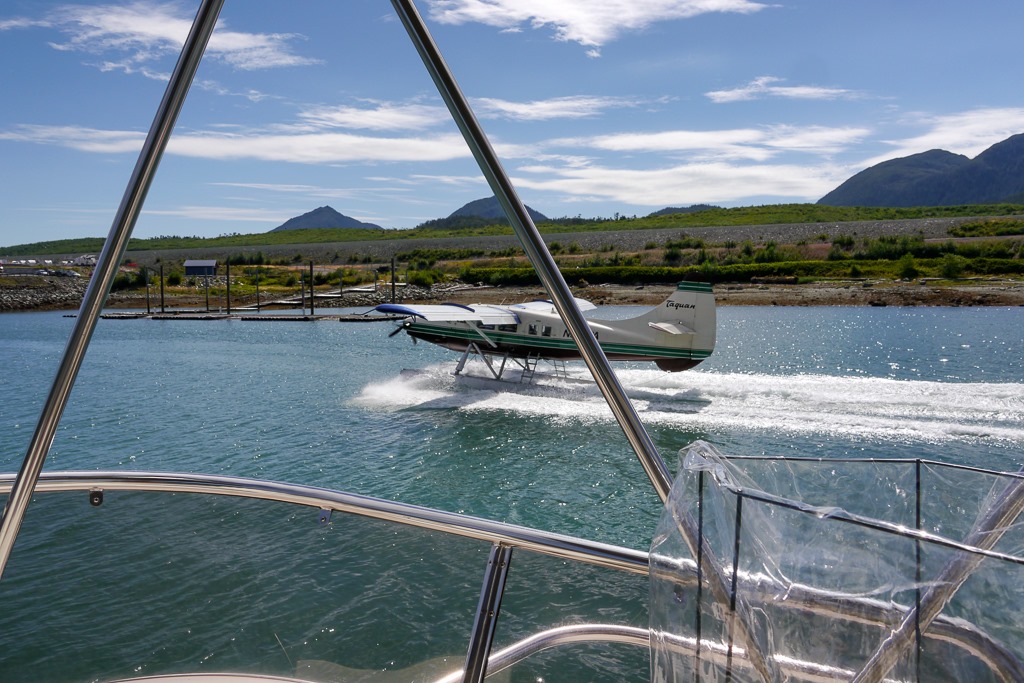
In Ketchikan harbour, this plane landed (watered?) right next to us, because…

We were trying to stay out of the way of this cruise ship on the other side.

There was Jan’s little visit to emergency, which we didn’t mention to anyone… False alarm – she was fine.


We made like tourists – wandered through town, did a little shopping (it’s amazing what you can buy in this tiny place), and enjoyed eating out.

Leaving Ketchikan and the cruise boat scene, we head back out into the wilderness. On the map below, the blue trace is our return route heading south.


Back in BC, this is the park headquarters for the Khuteymateen Grizzly Reserve in Khutzeymateen Inlet. It was staffed by a couple of very friendly Native fellows, who told us we weren’t allowed up the river at the head of the inlet.
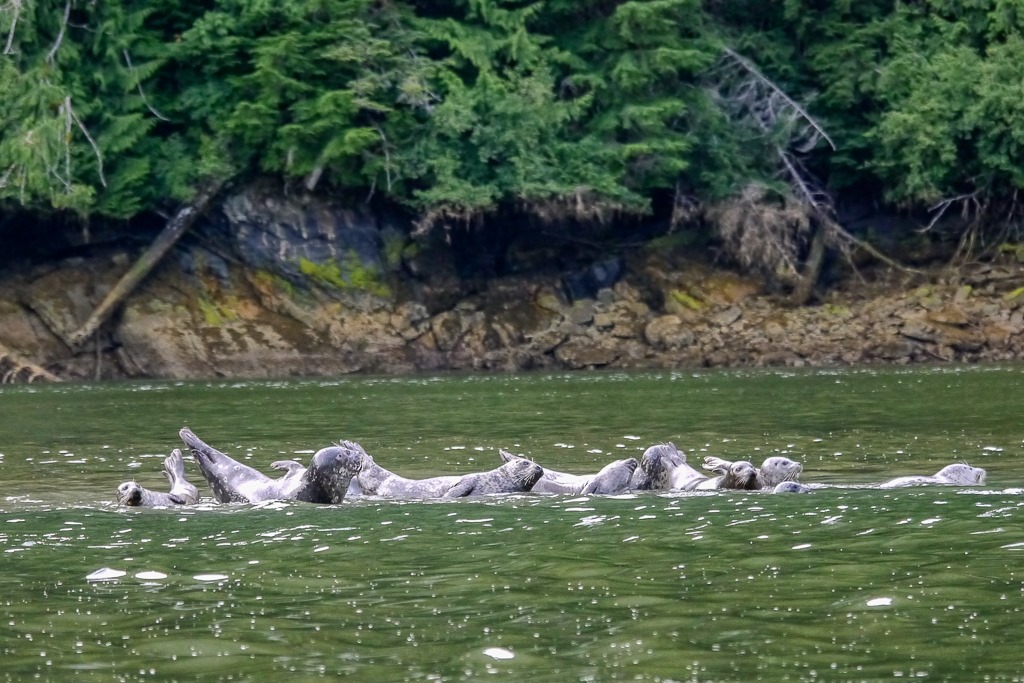
At the head of the inlet, we anchored and kept our eyes peeled for bears. Meanwhile these seals are jockeying for a basking spot as the tide goes out.

Next morning we were rewarded by this grizzly cruising around on the beach.


Other wildlife was out too – eagles on the shore, and lots of salmon in the water. The salmon were not biting, however, much to my frustration.

Just up from Khutzeymateen was Kwinamaas Bay, where we anchored and took the dinghy for several miles up this stream. This beach is a busy spot and is covered with tracks, like any city beach, the difference being that here all the tracks were made by wolves.

One misty and rainy morning….

When strange things went floating by….

And even the seagulls weren’t going anywhere….

We slept in, and then I made pancakes for breakfast.

Later that morning Jan decided to make cinny buns. Meanwhile, I decided to try some fishing. Just when Jan was up to her elbows in bread dough – guess what happened?

Yup, I hooked a big one! It was a scramble, with me all excited and shouting instructions, Jan wiping dough off her hands and bringing up the downriggers and getting the net. Finally we hauled in this big Chinook. We had salmon dinner and cured salmon snacks for days. Oh, and the cinny buns were excellent!

Just after the fishing excitement we spotted a group of Humpback whales. They started diving together so we were expecting to see bubble-netting happening.

We did actually see these whales bubble-netting but I didn’t get any photos. It was impossible to tell exactly where the whales were going to come up so I was always too late with the camera. (Unlike in Alaska, where we had warning from the gulls…). Anyway, this group was more graceful and co-ordinated than the Alaska whales, and it was a joy to watch.

A quick stop in Prince Rupert at the ‘big boat’ dock.

Jan flew to California for a few day, so I headed over to the Dundas Islands for a bit of poking around.

Moon snail egg case.

Lots of jellies in the anchorage.

Back in Prince Rupert to pick up Jan and resupply for the next leg south.

From Prince Rupert we went a ways up the Skeena River to the Cannery Museum.

Fuel stops are important to us, but this is one that we passed up.

Conveniently, the Cannery had a dock for us to tie up to.

The Cannery Museum is very interesting and well worth a visit.

However, we were here for a special dinner by invitation from this sushi chef.

The event was to be filmed for an episode of the Red Chef – a series focused on indigenous and local quisine around north america.

We had a very gourmet meal with tasty treats from four chefs including these bites from the Red Chef himself.

Leaving the Cannery, we headed further up the Skeena in search of some hot springs. Anchoring the boat, we continued up in the dinghy.

After some poking around and asking locals for directions, we finally found this faint trail into the woods.

A short way into the woods, there was a big tub full of excellent hot water.

South of the Skeena river, we stopped in at Kumealon Inlet. That night this seal insisted on sleeping on our back deck.

Next morning, I get deep into the foam.


The foam came from these huge tidal rapids flowing out from the Kumealon lagoon.

Jan tries on new earrings.

The Native community of Hartley Bay. This was the village that was so instrumental in the rescue of passengers from the sinking of the Queen of the North in 2006.

All the ‘streets’ are boardwalks.


While we were there the passenger ferry arrived from Prince Rupert. There was a lot of activity as people arrived loaded with groceries and supplies.

From Hartley Bay we went inland up Douglas channel in search of hot springs. Along the way was this juvenile Humpback whale breaching repeatedly.

The well-used hot tub at Bishop springs. Fortunately we arrived during a lull in the activity.

Bishop springs appears to be popular with the outboard crowd.

Further inland, up the Gardner Canal, we stop at the Shearwater (Europa) hot springs. There’s no dock, and no one else around.

We have a nice scenic soak.

Next morning getting the crab trap up was a challenge, as it had tangled with some underwater debris.

We did have a good haul of crabs, though. As usual we kept the two biggest ones and had a crab feast that afternoon.

A bit further up Gardner Canal, we stopped to hunt for a hot waterfall that we had been told about by a tour guide in Hartley Bay. We anchored in this rather precarious spot at the base of a cliff and headed across the inlet in the dinghy.

On the other side we landed at an equally precarious and steep shore.

Our efforts were rewarded by this natural hot shower. Lots of water. Perfect temperature. We came back refreshed and very clean.

Leaving Gardner Canal behind we head back toward the ‘outside’. Here we are about to enter the narrow passage to Cornwall Inlet (after waiting for the tide currents to ease) on the north end of Princess Royal Island.

Inside, there is a tranquil basin. We discovered this Native big-house tucked into the trees.

The weather turned rainy and we had these lovely misty views.

Jan paddling in the rain.

We paddled up the creek looking for fish and bears.

No bears but this young eagle was keeping an eye on us.


Back out in Whale Channel, this is the whale research station at the south end of Gil Island. They have microphones in the water to listen to the whales and are located here due to the whale population and the lack of commercial traffic noise pollution.

In Campania Sound we encounter Humpback whales engaged in ‘flick-feeding’ behaviour. The whale slaps the water with its tail then turns and lunges through the splash zone.


We continued south, along the west side of Princess Royal Island, stopping to explore Laredo Inlet.

At Quigley creek, there are salmon jumping everywhere. I am trying to get a photo of one but it was harder than it looked.

Meanwhile, Jan was patiently waiting, and doing more productive things like photographing fish under water.


I got a lot of shots like this….

Finally!

Further up the creek, I pulled this one off the bottom (very slippery and quite dead).

Jan under the hanging moss.

Fresh bread!

Nothing like a fresh bread sandwich.

Further up Laredo Inlet, at Alston Cove, we discovered ancient fish traps in the intertidal area. There were several large circles formed by piled up rocks all through the intertidal part of the estuary.

Waiting for high tide in Higgins Pass, we decided to explore some charted fish traps at a creek mouth. When we got out of the dinghy we spotted this group of… wolves! …running straight toward us. Gasp! We didn’t know what to do…

We scrambled back into the dinghy and pushed off. Here the head wolf is cruising the beach, checking us out.

After a while the wolves melt back into the forest, with the head wolf giving us a suspicious look. A few minutes later a chilling chorus of howls echoed through the forest. We were shaken, wondering what this was all about. Later we learned much by reading Ian McAllister’s book The Last Wild Wolves, in which this group features.

On the other side of Higgins Pass we came across this group of well camouflaged Sandhill Cranes.


The lighthouse at Dryad Point, at the north entrance to Bella Bella.

Native art in the islands south of Bella Bella.

A storm was forecast when we were in the islands south of Bella Bella. We tucked in to one of the coves in Spider Anchorage.

Putting out the crab trap by kayak in the rain.

Rainbow after the storm.

What to do after a storm? Why, go out paddling in the oceans swells, what else!

Happy 60th Birthday Janet! It’s Sept 11th, and Jan is spending her birthday at the beach on the north end of Calvert Island.

A Raven came by to sing happy birthday to Jan.

Raven tracks in the sand.

Dragonfly on the rocks.

Birthday dinner is salmon chowder.

And birthday cake!

Beautiful night sky.

At Open Bight, in the entrance to Rivers Inlet, we stopped to enjoy the beach.

Famous mid-coast sand cliffs.

Patterns in the sand.

Unique sand sculptures.

Finally, we round the notorious Cape Caution on our way south.

Our view from the anchorage in Miles Inlet. I always enjoy an anchorage with a view.

In Miles inlet there are numerous channels and lagoons to explore, and a couple of tidal rapids. Here Jan is running one.

Looks like she had fun!

Around the corner from Miles inlet is Nakwakto Rapids. We anchored nearby, took the dinghy to an island and hiked across to this viewpoint overlooking the rapids and Tremble Island in the middle.

Paddling the rugged and windswept islands in the Walker Group, north of Port Hardy.

We were watching a group of porpoises when we saw some Orcas approaching. Jan wondered whether they were residents or transients. I said, we’ll find out soon.

They turned out to be transients, and went into a hunting frenzy chasing down the porpoises.

After the successful hunt, this Orca spy-hops to check in there are any more porpoises around.

Artist studio warning sign in Sointula.

Dalls porpoises racing the boat in Johnstone Strait.


The old store at Port Neville.

Petroglyphs in Port Neville.

Shoal Harbour, looking up Phillips Arm. A great place to stop in for a beer.

Sunrise at Rebecca Spit on Quadra Island.

Heavy industry in Powell River.

A group of three Humpback whales in Georgia Strait, near Pender Harbour.

Anchored in scenic Smugglers Cove on the Sunshine Coast.

At the dock on Keats Island in Howe Sound. Almost home now!

Arriving in False Creek.

Finally back in the city! There was obligatory stop at Granville Island for coffee and snacks, then we anchored in False Creek overnight. The next day, Sept 29th, we tied up at the Fishermans’ docks and walked home to get the car, resume our regular lives, and dream about whales gone by.

End
.