

In February 2018 Janet bought this lovely boat for our planned cruise to Glacier Bay. We spent 5 months aboard, leaving at the beginning of May and returning at the end of September.
Below is a Google map of our route. If you click on the “view larger map” icon at the top right, the map will open in a new window and you can zoom in for more detail. The yellow and green sections are the northbound route, and the blue and red sections are southbound. (Note: Not to be used for navigation…)
Before we headed north, we headed south. We needed to go to Canoe Cove to have the Seawise dinghy hoist installed.

Anchored in the gulf islands, with the dinghy in tow. While anchoring, I backed up over the dinghy towline and wrapped it around the prop(!). Next morning I went for a swim, diving under the boat to unwrap the line.


We stopped for lunch at the Fernwood dock on Saltspring.

We spent a couple of days tied to the dock in Canoe Cove while the work was done. Not the most scenic stopover!

Here is dinghy hoist finally installed thanks to Malcolm and Connie working all weekend.

Raven Song gets lifted out in order to install the boarding ladder. We spent the night aboard suspended in the slings…

Our view from up in the slings. Early in the morning we are launched again and the trip north begins!
The date is May 1st. Below is a map of the first leg of the trip.


Heading north through the Gulf Islands, we come across these aspiring pirates. They were still learning the ropes and we escaped with a few pictures and some cheering and waving.

Peltroglyph in Degnen Bay, on the south side of Gabriola Island.

Sea lions on the dock at French Creek.

A couple of long days of cruising up Georgia Strait finally brings us to narrow waterways on the east side of Quadra Island.

First fish of the trip!

Bruce, who had been along for a few days, leaves us at the dock in Sayward.

The Port Neville store, which is sort of a museum, though it was closed and no one around when we were there.

Peering in the windows of the old store.

Anchored in Port Neville.

Petroglyph on the shore at Robber Point in Port Neville.

Floating cabins in Potts Lagoon in the Broughton Archipelago.

We stop in Alert Bay to have a look around.

Near the museum, we are directed to a tent where new carvings are being made.

These new poles are apparently destined for a theme park in Belgium.

The Glenda returns to the earth a little more each time I come by.

One of the National Geographic cruise ships stops in at Alert Bay. We saw several of these small cruise ships over the course of the summer.

More logs out of the forest.

Janet sizes up the world’s largest burl, in Port McNeil. We spent a couple of days in Pt McNeil re-supplying. Janet left to go to California for a few days, and Dave joined me for the next leg to Bella Bella.


Stuck between a rock and and island.


Windblown shores of Queen Charlotte Strait

A foggy morning greets us at our first anchorage north of Cape Caution.
Once around Cape Caution, we are north of Vancouver Island and officially on the BC Mid-Coast.

Dave on the amazing white shell beach at Penrose Island anchorage.

Sea Lion rock at Penrose Island.
 The Hakai Research Institute on the north end of Calvert Island. Formerly a fishing lodge, it is now a centre for education and research about the coastal environment.

At the research institute there are trails to nearby outer beaches, so Dave and I spent a sunny afternoon on the beach.

Humpback whale in Fitz-Hugh Sound.

Log barge going back for more…

We cruised by Namu without stopping. There used to be a dock but now the place was literally falling apart and there was no access.

At Codville Lgoon, just off Fitz Hugh Sound, there is a trail to a big lake with a pink sand shore. We went for a quick (chilly) dip!

The dam at Ocean Falls still provides power to the town and also to Bella Bella.

However Ocean Falls is pretty much a ghost town. The huge pulp mill is gone, just a few ruined buildings left.


The Ocean Falls mermaid waves to us as we depart.
Arriving in Bella Bella was a big stop. Dave disembarked to take the (2am!) ferry back to Port Hardy. Janet arrived the next morning on the plane.

Then we proceeded to clean up the boat and re-supply.

Here is the Raven Song at the Bella Bella dock, where we loaded up on what groceries we could find at the Native store.

Around the corner, at Shearwater, Raven Song is dwarfed by her neighbours.
Below is a map of the next leg – from Bella Bella to Prince Rupert. We left Bella Bella on May 20th.


Near Bella Bella was a petroglyph site where we stopped to investigate, and Janet made some rubbings.

A bit further up the coast we came across this commercial Prawn boat.

We reached over with a bucket (with some cash) at the end of a pole and they sent back this bucket full of prawns!


We had a great prawn dinner that night!

The Bighouse at Klemtu.


Cruising up the Inside Passage past the landmark Boat Bluff lighthouse.

Departing the classic Inside Passage, we took the “Outer Inside Passage” up Laredo Channel. Here we explored some inlets with narrow entrances and strong tidal currents.

The beautiful white sand beaches of Campania Island.


The next day it rained…

A great day for route planning.

The calm after the storm created some great rock totems.

How about fish for dinner? Ten minutes later we had this nice ling cod.

Careful navigation is required around Dolphin Island.


The picturesque settlement of Oona River.
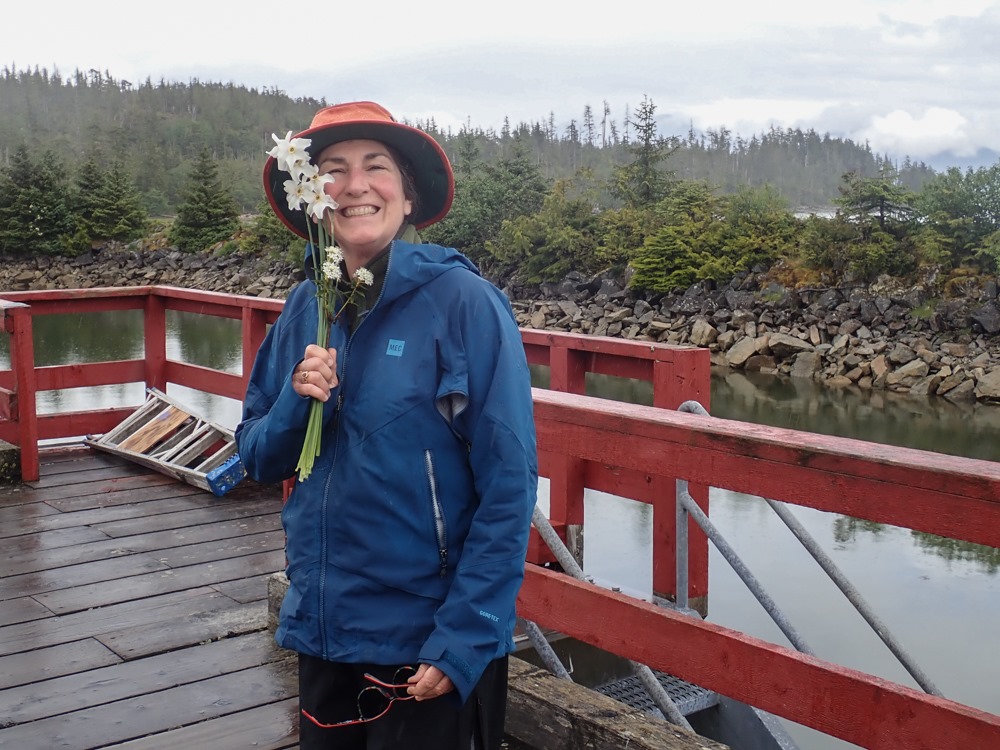
Jan picks a feral roadside bouquet.

One of many crab dinners.

Floating rainbow.

We arrive in Prince Rupert on May 30th.

Prince Rupert is our first decent sized town in a while, so we indulge in going out for drinks, above, and shopping, below.

Janet buys a new hat for the coastal weather!

We buy a larger fishing net – that last ling cod almost jumped out of the old net!

At the excellent Museum, we saw beautiful traditional carvings, above, and dramatic modern carvings, below.

This carving represents the spirits leaving a Shaman upon his death.

Just north of Prince Rupert, near the Native village of Metlakatla, are numerous petroglyphs on the beach. The petroglyphs can be surprisingly hard to see – this one is outlined in chalk to make it more visible.


The petroglyphs are eroding over time. Compare the faint patterns we outlined in chalk with the photo in our guidebook (dating from the ‘70’s).

This pattern is common – a simple face in the rock.

The petroglyphs are all in the intertidal area.

The most famous petroglyph in this area is “the man whole fell to earth”. No one knows the significance of this unique life-sized carving. Janet is making her own imprint in the grass, as is a furry friend that followed us here.

Art on the walls of the school in Lax Kwalaams (Port Simpson).

Leaving Lax Kwalaams. This was the site of the first Hudsons Bay post on the coast.

Bear grazing on the shore.

We see the first of many supply barges bringing goods to Alaska.

During a rough crossing, Janet sticks to her knitting.

When it’s rough out, Harald makes sure his coffee pot is secured!

Suddenly we are in Ketchikan.

Ketchikan is a small town dominated physically and economically by the cruise ship scene.

We take a few minutes to do the touristy thing (above) but mostly our time is spent with laundry (below), and grocery shopping.


From Ketchikan, we headed south and west to take the outer, but still mostly protected, route to Sitka.

Our first stop on this leg is the Native village of Metlakatla.

The Scottish missionary William Duncan moved his ‘flock’ here from the Metlakatla near Prince Rupert in 1887. This story is an interesting slice of coastal history.
Metlakatla is the only Native reservation in Alaska.

The missionary influence shows in some of the local totem poles.

We had a snack at the local ‘restaurant’ at the back of the grocery store. I’m going back soon for the Fingersteaks!

At the dock, Harald takes the opportunity for a trim.

Near Cape Chacon, at the south end of Prince of Wales Island, Harald catches his first halibut!

At one of our anchorages we took the kayaks out for a paddle among a group of islands.

A big bear grazing on the shore.

Our next stop was Hydaburg – a Haida village with an interesting totem park in the centre of the village. There is an unusual stone sculpture of what appears to be a seal, in the centre of the park.


Unique to the region is the double-finned orca.

The poles in the village park were all new – recently carved in this nearby carving shed – and replaced older, deteriorating totems.

After Hydaburg, we stopped in at Craig, a slightly larger fishing community.

We took the opportunity to go out for breakfast!

And do some local shopping. Jan is eyeing up the XtraTuff boots, which is what Everyone wears in Alaska – no kidding!

This is the best selection of gaff hooks ever.

Grocery stores are always a fun place to explore local cuisine.

Lots and lots of coffee choices, as long as its Folgers.

And a large selection of sophisticated treats, including donettes.

Janet takes advantage of the nice weather to plant her garden. The garden never did amount to much – it just didn’t get warm enough for things to grow.

Harald gets charts out for the next leg.

Near the north end of Prince of Wales Island. we stopped in for a shore excursion to see this very large cave.

Here’s Jan exploring some of the cave’s narrow passages.

After the cave, we negotiated the narrow passages of El Capitan Pass with its numerous navigational markers.

After that navigational challenge, we are relaxing with a beer on the upper deck.

Sea Otters have been with us throughout Alaska.

The Sea Otters are very cute, and fun to watch individually or in large groups. However they keep the crab population under control so we never can catch any crabs when the otters are around.

Jan keeping bow watch as we check out an anchorage with a very narrow entrance.

Jan collecting ‘newspaper kelp’ during a really low tide.

A navigational challenge was Keku Strait, with tidal currents and lots of twists and turns including the infamous Devils Elbow.

After the challenging Keku Strait, our evening anchorage featured a feeding humpback whale (above) and a cliff walking bear (below).

The next day, out in Frederick Sound, we came across a couple of humpback whales who were having a good time splashing around.

There was repeated breaching.

Flipper waving. This whale is swimming upside down with her flippers in the air.

And lots of vigorous tail slapping.

We stopped in at Warm Springs Bay, on the east side of Baranof Island.
We were very excited to find the public bath house at the top of the dock. Unlimited hot water direct from the hot springs, and a huge tub with a view.

Up a short trail are the hot springs, next to this raging stream.

Jan is looking a little tense, as she tries out the outboard for the first time.

More relaxed now, Jan has a morning cup of tea at the dock by the waterfall.

After cruising around the top of Baranof Island through Peril Strait, we finally arrived in Sitka on June 21st. Summer solstice, and the days are looonng!

One of Sitka’s many ravens flies over Raven Song at the Sitka docks.

Mt. Edgecumbe is the volcano that dominates the Sitka skyline.

We cruised out to St. Lazaria islands to discover an amazing landscape full of wildlife including whales, sea lions, and lots of birds.

A huge flock of Murres.

And best of all – lots of Puffins!


From the Sitka area we headed south along the outer coast for a few days.

We stopped in among some islands for a paddle.

There are hot springs along this coast. The hut near the shore, maintained by the Forest Service, has a sheltered tub of hot springs water.

A hot soak with a view.

There was a fisheries opening so we numerous commercial fishing craft in the area.

We went on a fishing excursion of our own and were met with success!

Returning to Sitka after our little jaunt to the south, we are approaching the busy harbour under the airport bridge.

Janet out on a grocery re-stocking expedition.

We toured some of the historical sights.

Evidence of the past – the Tlingit Native residents and the Russian missionaries.

And of course we took time to sample the local brew. This stuff was so good I barely got my camera out before it was all gone!

Heading north from Sitka, we cruised a stretch of open coastline, rolling around in the ocean swells.

An outer coast beach beckoned, so we anchored and paddled in. No one else there – not only is it remote, but the weather was marginal too. We did get in some fun kayak surfing, though.

Tucking in behind some outer islands, we share an anchorage with a commercial fisher.

That’s Jan paddling in the ocean swells. Numerous islands made this a great area to paddle and explore.

The weather improved the next day as we navigated through rocky passages.

From our anchorage in the islands, we paddled to the ‘outside’, around all the islands in the picture, to come to this spot where there are hotsprings on the shore.

Another fabulous soak with a great view!

Leaving our tiny anchorage in the islands.

Our next stop provided more great paddling opportunities.

Jan in the kelp. Some of which she harvested for a future dinner.

Here’s the kelp drying on the upper deck.

Turning up Lisianski Strait, we left the ocean swells behind. A ways down scenic Lisianski Inlet we stopped in at the little village of Pelican.

Pelican’s main street is a boardwalk.

There was an actual heat wave happening, which allowed us to sit out in t-shirts and bare feet. The locals were complaining that their Xtra-Tuf’s were too hot.

We stayed for the 4th of July festivities, including fireworks at 11pm (not quite dark…)

Next day there was a parade.

All kinds of races, including the fun wheelbarrow race.

The “paddle what you brung” race. These guys are valiantly claiming last place.

And the ever-popular grease pole. Here the winner is about to snatch the little flag for the cash prize.
.